⏱️ 90-Second Micro Lessons·Bilingual (English & Hindi)·Free For Every Kitchen
Daily Kitchen Briefings.
Practical pre-service huddle lessons for India’s restaurant and hotel brigades. Play one with your team before every lunch and dinner service. Watch. Discuss. Ask. Execute with confidence.
🔍
Showing 14 lessons
⏱ 1:50
EP 01
How to Wash Hands the Pro Kitchen Way — FSSAI 8-Step Method
हाथ धोने का सही तरीका — FSSAI का 8-Step Method
The single most fundamental discipline in a commercial kitchen — and the one most consistently done wrong. Use this 90 seconds to reset the team's default.
Watch 90s Lesson →
⏱ 1:41
EP 02
ONE COLOR, ONE JOB — Color-Coded Cutting Boards Explained
एक रंग, एक काम — Color-Coded Cutting Boards
Cross-contamination starts on the cutting board. Six colours, six jobs — the discipline that separates safe kitchens from disasters.
Watch 90s Lesson →

⏱ 1:49
EP 03
What Goes Where in the Fridge — Top-to-Bottom Shelf Rules
फ्रिज में क्या कहाँ रखें — Top-to-Bottom Shelf Rules
The shelf you put your chicken on can put a guest in hospital. Top-to-bottom hierarchy is not decoration — it's drip physics.
Watch 90s Lesson →

⏱ 1:40
EP 04
The 1-Minute Habit That Saves Your Whole Shift — Clean As You Go
1-Minute की आदत जो पूरी shift बचाती है — Clean As You Go
Two hours of extra scrubbing at end of shift — or three seconds every minute. This is the discipline that separates smooth kitchens from chaotic ones.
Watch 90s Lesson →
⏱ 1:49
EP 05
When a Guest Sends a Dish Back — The LAST Framework
जब guest dish वापस भेजे — LAST Framework
A complaint isn't an insult — it's feedback. Four steps: Listen, Apologize, Solve, Thank. This is the protocol every team member must know.
Watch 90s Lesson →

⏱ 1:51
EP 06
One Bandaid Closed This Restaurant — Personal Hygiene Disaster
एक Bandaid ने पूरा restaurant बंद करवा दिया — Personal Hygiene
One skin-tone bandaid in a bowl of potato salad. Dozens of guests in hospital. This is what happens when three basic personal-hygiene protocols get skipped.
Watch 90s Lesson →
⏱ 1:48
EP 07
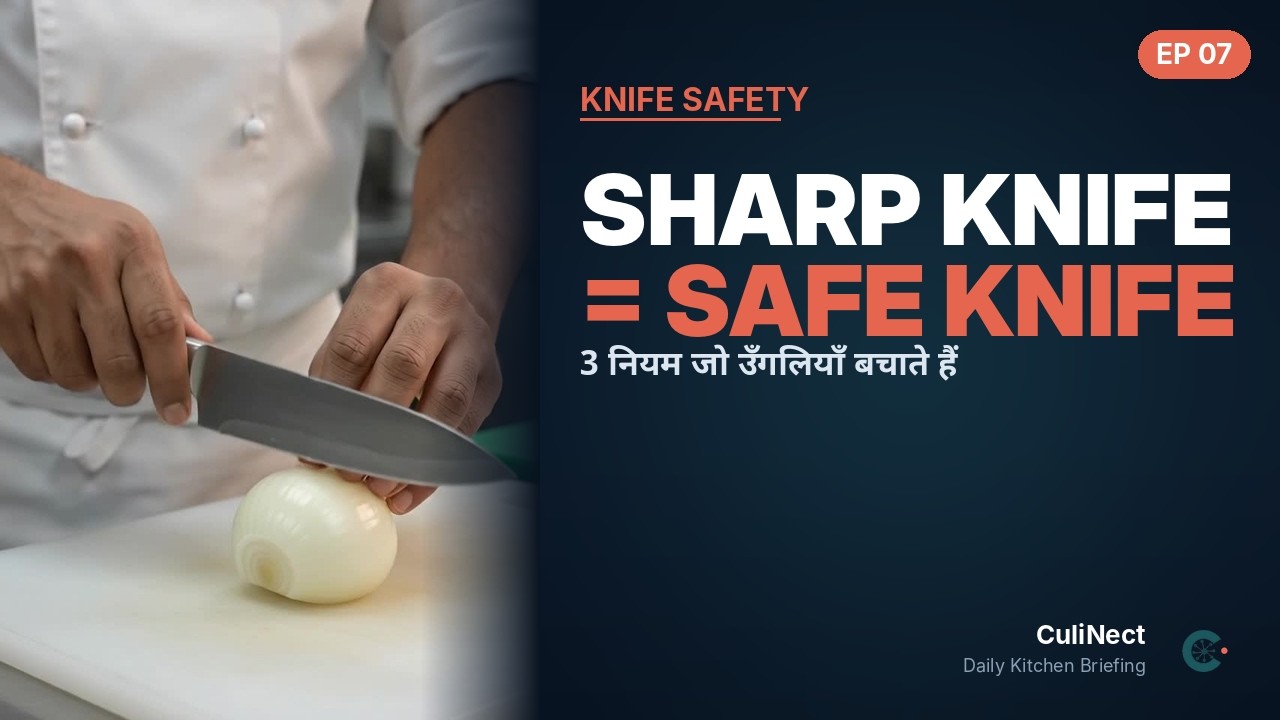
The 3 Knife Rules That Save Your Fingers — Sharp = Safe
3 Knife Rules जो उँगलियाँ बचाते हैं — Sharp = Safe
Most cuts happen with dull knives, not sharp ones. Three rules — Sharp, Grip, Step back — that separate professional kitchen safety from injury.
Watch 90s Lesson →

⏱ 1:49
EP 08
3 Labels Every Container Needs — Item, Date, Initials
3 Labels हर container पर — Item, Date, Initials
One sticker with one word isn't a label — it's trash. Three fields on every container: what, when (prep + use-by), who. That's FIFO's foundation.
Watch 90s Lesson →

⏱ 1:54
EP 09
The 5°–60° Danger Zone Rule Every Chef Must Know
5°–60° का Danger Zone Rule — हर Chef को पता होना चाहिए
Between 5°C and 60°C bacteria double every 20 minutes. One tray of chicken left at 22°C for two hours is not late — it is contaminated. Senior chef Priya (channel debut) catches junior commis Aisha's mistake and teaches the temperature rule that separates safe kitchens from FSSAI-shutdown ones. This is the CCP that HACCP is built around. Play it before every service. Lock it before you touch a raw protein again.
Watch 90s Lesson →
⏱ 1:54
EP 10
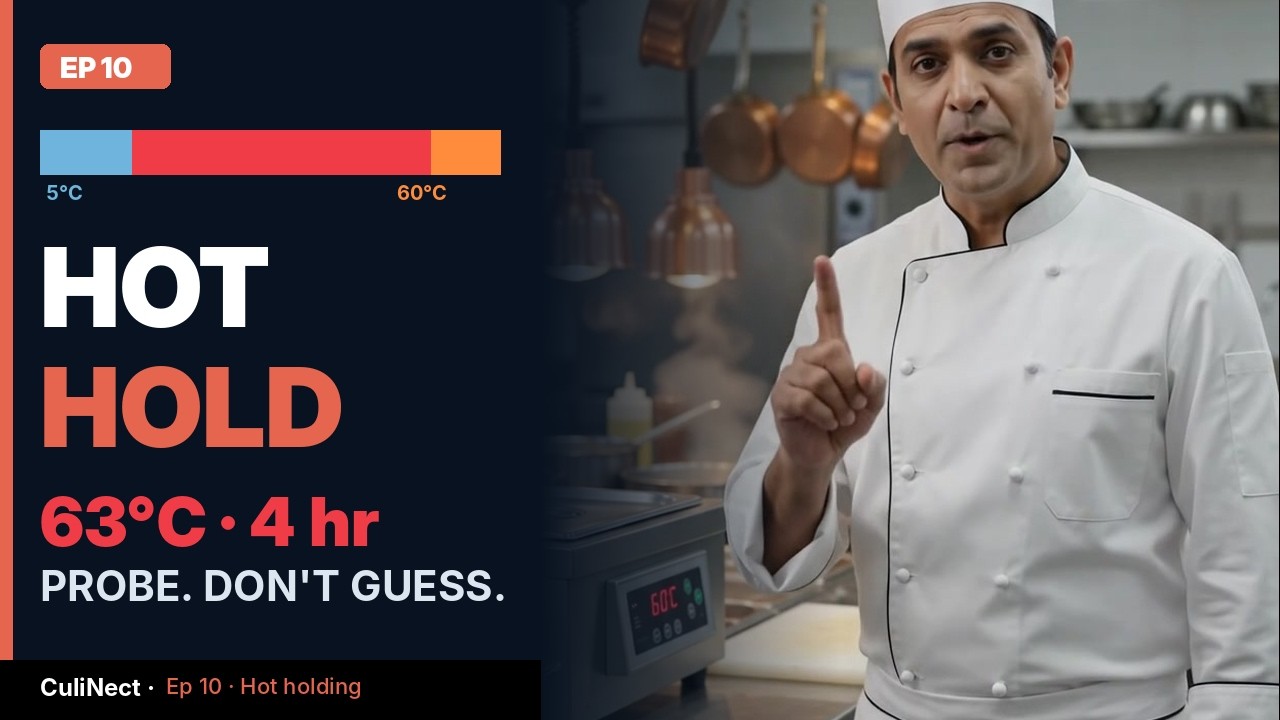
Hot Hold ≥63°C, 4 Hours Max — The Buffet Rule Nobody Follows
Hot Hold ≥63°C, 4 घंटे Max — वो Buffet Rule जिसे कोई नहीं follow करता
Your bain-marie is bubbling. That means nothing. Probe the dal at the centre — what temperature is that? THAT number is what matters. Not the water. Not the pan. The food. Chef Priya teaches the hot-holding rule that separates buffets that pass FSSAI audits from ones that get shut down: internal ≥63°C, 4-hour cumulative maximum, probe every 2 hours, one-time reheat to 74°C, then discard. And the 2/4 cooling rule that stops Clostridium perfringens from growing overnight in your walk-in.
Watch 90s Lesson →

⏱ 2:10
EP 11
The Walk-in Discipline: ≤5°C, Top-to-Bottom, FIFO
Walk-in Discipline: ≤5°C, Top-to-Bottom, FIFO
Your walk-in isn't storage. It's a hierarchy — and a clock. Chef Priya walks you through the discipline that runs every professional kitchen: the ≤5°C hold, the top-to-bottom shelf order that stops cross-contamination, the three labels every container must carry, FIFO (First In First Out), the strip curtain rule, and the mistakes that quietly spoil a kitchen's cold chain. Play this before service. Your bottom shelf is where raw chicken belongs — not on top of the cooked curry. And that container without a date? Bin it.
Watch 90s Lesson →
⏱ 1:54
EP 12
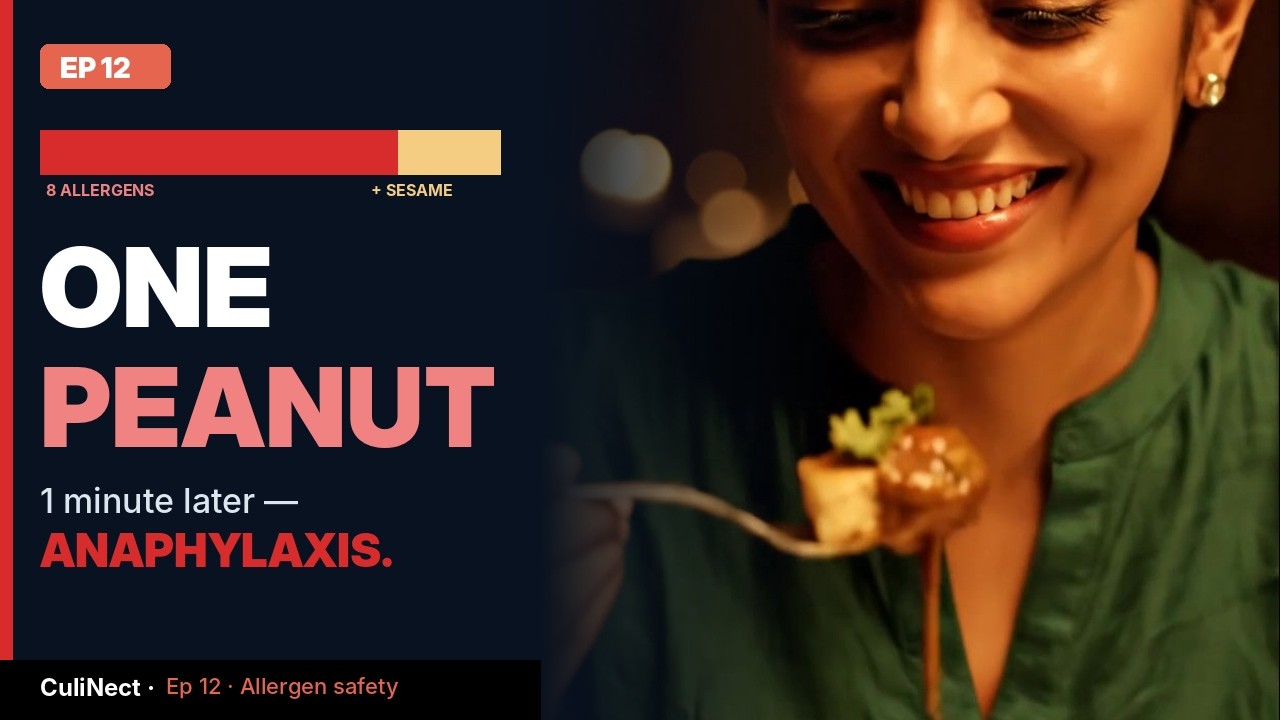
The Peanut on the Pastry Board — FSSAI 8 Allergens
The Peanut on the Pastry Board — FSSAI के 8 Allergens
A guest declares peanut allergy at booking. The kitchen thinks — no peanut on the menu, so we're safe. One hour later she's on a stretcher and the EpiPen slot is empty. In 2 minutes Chef Priya walks you through the FSSAI 8-allergen rule that 90% of Indian kitchens still ignore — the invisible cross-contact that happens on the same knife, the same board, the same wiped-not-sanitised surface. And the 4-step protocol every host and chef must know: Ticket · Tools · Kit · Handover.
Watch 90s Lesson →
⏱ 2:07
EP 13
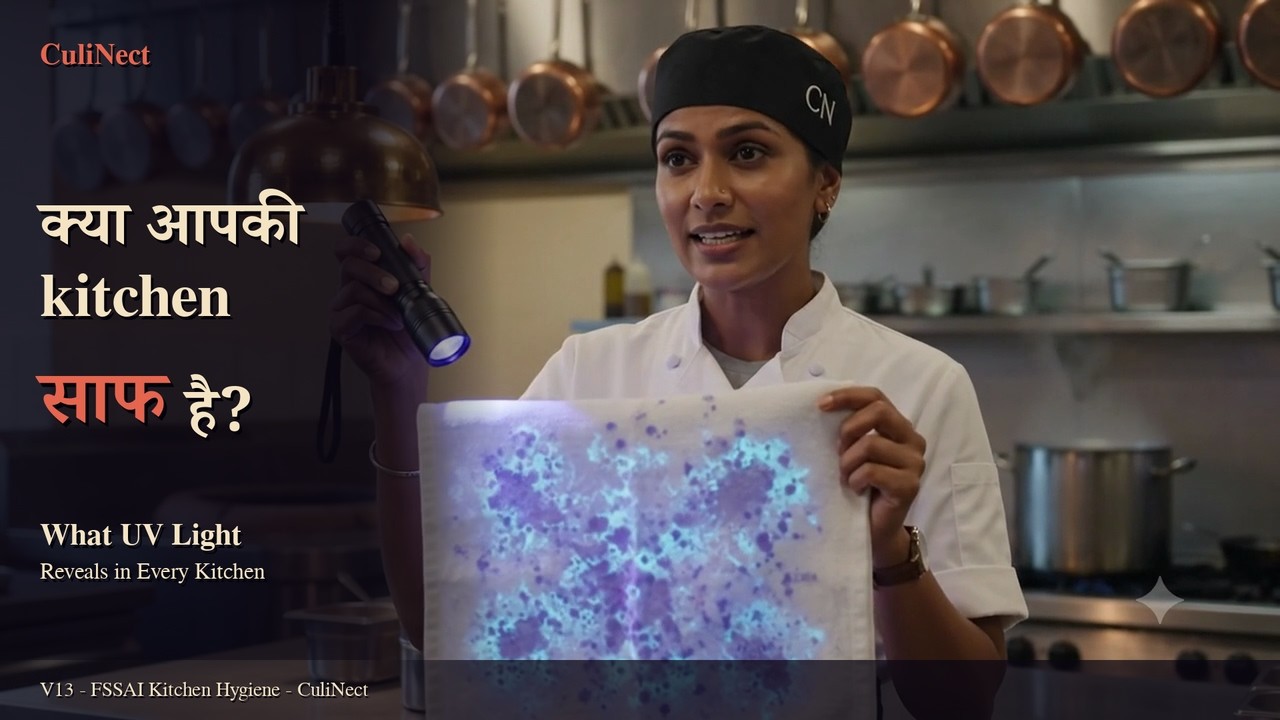
क्या आपकी kitchen 'साफ' है? UV Light ने खोले 4 hidden bacteria hotspots
क्या आपकी kitchen 'साफ' है? UV Light ने खोले 4 hidden bacteria hotspots
Your kitchen looks spotless. Wipe the counter — nothing on your hand. Chef Meera Iyer takes a UV blacklight torch through a modern professional kitchen and reveals four hotspots that every shift leaves behind: the counter itself (grease + biofilm smeared, not removed), the chef's knife handle (blade goes in the dishwasher, handle doesn't), the walk-in fridge gasket (a rubber-fold biofilm factory), and the tea towel (uniform contamination — the worst offender). And the twist: the owner walks in with her tablet. Meera turns the UV on the tablet. The tablet glows worst of all. Cleaning ≠ sanitizing. Detergent removes soil; sanitizer kills what remains.
Watch 90s Lesson →

⏱ 3:46
EP 14
One Cockroach. One Week. One Lesson. — Pest Control: A Learning Story
एक cockroach। एक हफ्ता। एक lesson। Pest Control — A Learning Story
A junior sous chef is on prep. A cockroach darts out from under the walk-in. And then he remembers — he saw one last week too. But he never told anyone. The next 4 minutes trace the HACCP investigation flow in real time: incident, three findings, the licensed pest control officer's root-cause interrogation, the confession, the corrective actions, the log book, and the lesson. Because in a professional kitchen, the most dangerous sentence is: 'मैंने देखा था पर बताया नहीं।'
Watch 90s Lesson →